

1. Start with Technical Upgrades
Before renovating the visible parts of your home, first check the electrical system, plumbing, heating, ventilation, insulation, solar energy and future space requirements. Planning these systems early prevents repeated demolition, unnecessary costs and future repairs. We will explain each area step by step—starting with the electrical installation.
• Electrical Installation & Meter Box
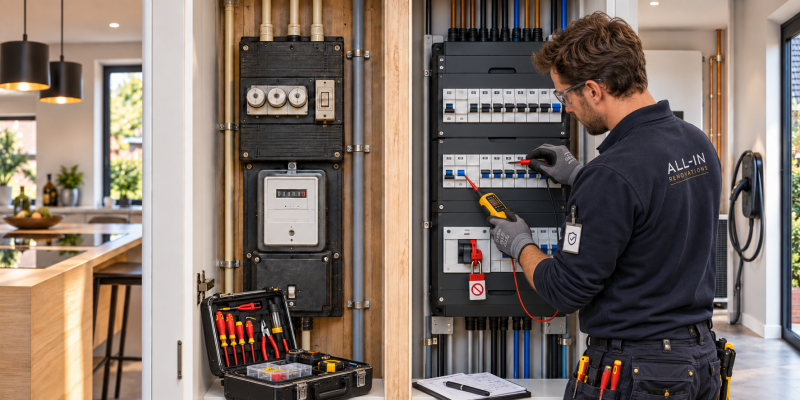
Have you bought a new home or are you renovating your current property? The electrical system should be one of the first things you check. We start by reviewing your meter box, current energy use and phase connection. If your renovation includes high-power equipment, we may recommend a three-phase connection. If this is not necessary, we continue with the existing system.
We then check whether the electrical groups are correctly and safely distributed, whether new groups are required and whether the meter box needs updating. Heavy equipment may be connected to the wrong group, or old wiring may have been repeatedly extended. We correct these issues, organise the installation and add the necessary protection and warning devices. This reduces the risk of overloaded circuits, power failures, electrical faults and fire. If the installation is already in good condition, we can also help with smaller work such as adding or moving sockets, switches, lighting points and other electrical connections.
Recommended Quality & Brands
- Meter Box & Circuit Protection: Hager, ABB or Eaton
- Sockets & Switches: Gira, Jung or Berker
- Electrical Cables: Draka or Prysmian
- Safety Protection: RCBOs, main switch and surge protection
- Completion: Updated circuit schedule, final testing and certified installation
Note: Converting a property from a single-phase to a three-phase connection requires two separate steps. First, the meter box must be prepared by a certified electrical installer. The grid connection and electricity meter are then upgraded by the network operator. The network operator’s costs are charged separately and may vary depending on the property and required work.
• Plumbing & Drainage Renovation

Have you bought a new home or are you renovating your current property? The water supply and drainage system should be one of the first things you check. We start by reviewing the main water connection, water pressure, visible pipes and the drainage points in the kitchen, bathroom, toilet and utility room.
In older homes, we check for lead, galvanised or damaged pipes. We also inspect the water flow, drainage slope, pipe connections, ventilation and possible leaks. If necessary, we use a camera to inspect the main sewer line for blockages, cracks or collapsed sections.
If everything is safe and working correctly, we continue with the existing system. If a problem is found, we repair only the necessary section. During a complete renovation, old pipes hidden behind new walls or floors may be better replaced in advance. This helps prevent leaks, blockages, unpleasant odours and unnecessary demolition later.
Recommended Quality & Brands
- Water Pipes & Fittings: Viega, Geberit or Uponor
- Drainage Pipes & Fittings: Wavin or Dyka
- Concealed Toilet Systems: Geberit or Grohe
- Valves & Water Connections: Viega, Bonfix or VSH
- Sealing & Installation Materials: Griffon or Soudal
- Completion: Pressure testing, drainage-flow testing and leak inspection
Note: Before closing the walls and floors, we also consider your future plans. If you may later add a second bathroom, utility room, kitchen or extension, the required water and drainage connections can be prepared in advance. If the existing installation is already suitable, no unnecessary work is carried out and there is no unnecessary cost.
• Electrical Installation & Meter Box
Have you bought a new home or are you renovating your current property? The electrical system should be one of the first things you check. We start by reviewing your meter box, current energy use and phase connection. If your renovation includes high-power equipment, we may recommend a three-phase connection. If this is not necessary, we continue with the existing system.
We then check whether the electrical groups are correctly and safely distributed, whether new groups are required and whether the meter box needs updating. Heavy equipment may be connected to the wrong group, or old wiring may have been repeatedly extended. We correct these issues, organise the installation and add the necessary protection and warning devices. This reduces the risk of overloaded circuits, power failures, electrical faults and fire. If the installation is already in good condition, we can also help with smaller work such as adding or moving sockets, switches, lighting points and other electrical connections.
Recommended Quality & Brands
- Meter Box & Circuit Protection: Hager, ABB or Eaton
- Sockets & Switches: Gira, Jung or Berker
- Electrical Cables: Draka or Prysmian
- Safety Protection: RCBOs, main switch and surge protection
- Completion: Updated circuit schedule, final testing and certified installation
Note: Converting a property from a single-phase to a three-phase connection requires two separate steps. First, the meter box must be prepared by a certified electrical installer. The grid connection and electricity meter are then upgraded by the network operator. The network operator’s costs are charged separately and may vary depending on the property and required work.
• Plumbing & Drainage Renovation
Have you bought a new home or are you renovating your current property? The water supply and drainage system should be one of the first things you check. We start by reviewing the main water connection, water pressure, visible pipes and the drainage points in the kitchen, bathroom, toilet and utility room.
In older homes, we check for lead, galvanised or damaged pipes. We also inspect the water flow, drainage slope, pipe connections, ventilation and possible leaks. If necessary, we use a camera to inspect the main sewer line for blockages, cracks or collapsed sections.
If everything is safe and working correctly, we continue with the existing system. If a problem is found, we repair only the necessary section. During a complete renovation, old pipes hidden behind new walls or floors may be better replaced in advance. This helps prevent leaks, blockages, unpleasant odours and unnecessary demolition later.
Recommended Quality & Brands
- Water Pipes & Fittings: Viega, Geberit or Uponor
- Drainage Pipes & Fittings: Wavin or Dyka
- Concealed Toilet Systems: Geberit or Grohe
- Valves & Water Connections: Viega, Bonfix or VSH
- Sealing & Installation Materials: Griffon or Soudal
- Completion: Pressure testing, drainage-flow testing and leak inspection
Note: Before closing the walls and floors, we also consider your future plans. If you may later add a second bathroom, utility room, kitchen or extension, the required water and drainage connections can be prepared in advance. If the existing installation is already suitable, no unnecessary work is carried out and there is no unnecessary cost.